
Embracing the Quiet Wonder of Open Skies
Stepping into an unlit country paddock after sunset can feel like crossing a gentle threshold. The last sounds of the day settle into the grass, fence lines become soft silhouettes, and the sky opens without the bright interruptions familiar from towns and cities. On quiet acreage, even an ordinary evening can offer a fine view of the Moon, familiar stars, wandering planets, or a brief meteor passing overhead.
Pastoral stargazing asks very little of you. A warm blanket, a sheltered patch of meadow, and an unobstructed horizon are enough to begin. The pleasure lies in slowing down rather than collecting observations. Leave the phone indoors or keep it switched off, allow the eyes to grow accustomed to the dark, and let the evening unfold at its own unhurried pace. For guests at a rural lodge or countryside retreat, this simple ritual can become one of the most restorative parts of a stay.
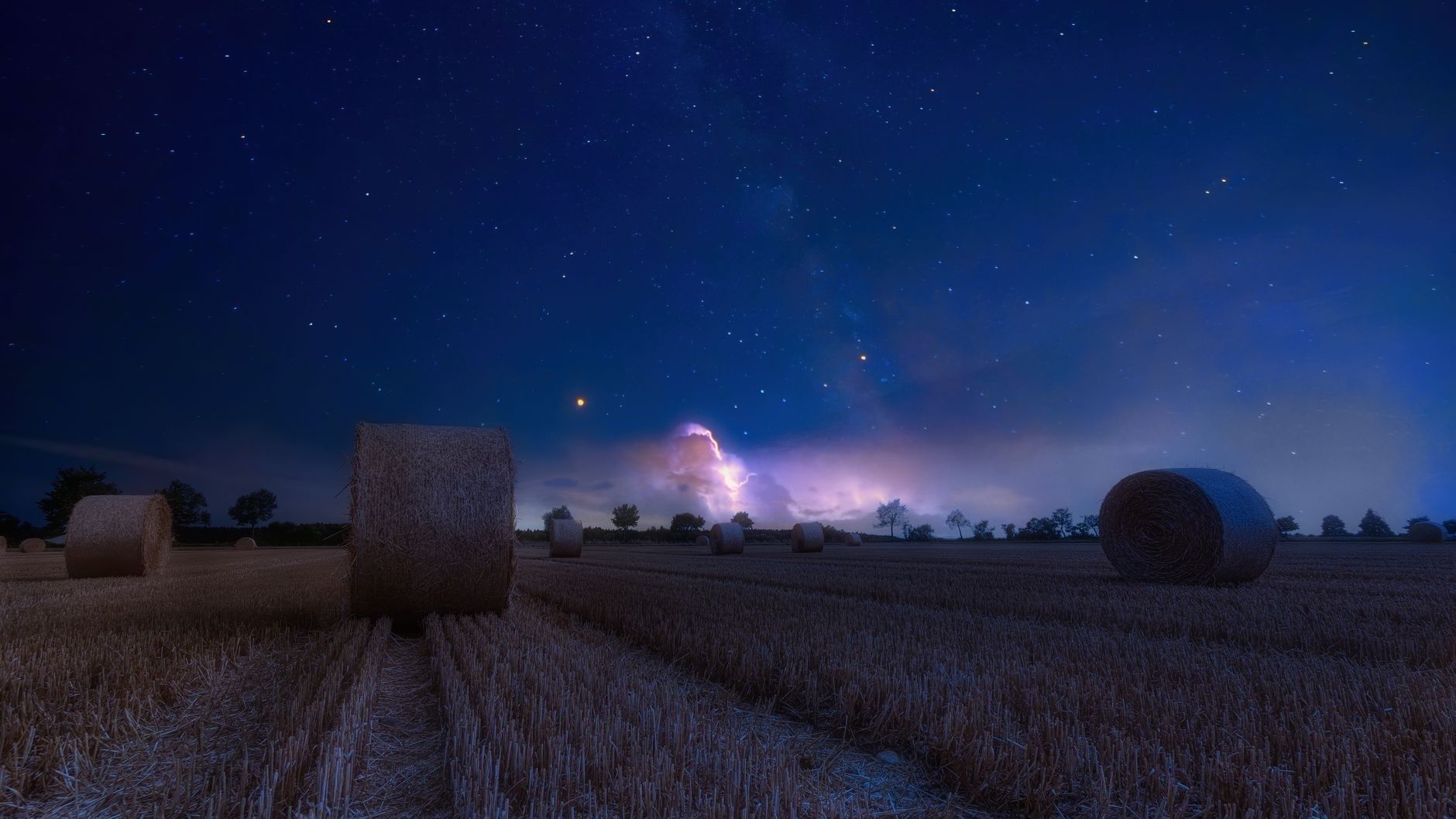
Cultivating Natural Dark Adaptation in the Countryside
The night sky does not reveal all its detail at once. When you first leave a lit room, the eyes are still relying heavily on cone cells, which support color and sharp vision in brighter conditions. Over approximately twenty to thirty minutes in darkness, rod cells become increasingly important. Rods are more sensitive to faint light, allowing dim stars and subtle stretches of the Milky Way to emerge gradually. The change can be surprisingly noticeable: a patch of sky that seemed empty at first may begin to show layers of stars.
Artificial light is the main obstacle to this adjustment. Before settling outside, ask that porch lamps, stable lights, pathway fixtures, and nearby indoor lighting be switched off or shielded where practical. A small red light is preferable to a bright white flashlight because it is less disruptive to night vision. Keep the beam directed toward the ground, use the lowest useful brightness, and avoid looking directly into another person”s lamp. National Park Service astronomy guidance explains how allowing the eyes to adjust naturally helps observers notice faint celestial details without artificial aids.
- Give the eyes at least twenty minutes, and ideally closer to thirty minutes, before judging the quality of the sky.
- Choose a position away from porch illumination, vehicle headlights, and bright windows.
- Use a dim red light only when necessary, keeping it covered or pointed down.
- Bring layered quilts, wool throws, and a reclining lounger so comfort does not interrupt observation.
- Keep a warm drink nearby, since stillness becomes much easier when hands and feet remain warm.
Comfort matters more than many first-time observers expect. A reclining lounger reduces neck strain and makes it easier to scan the sky slowly, while layered quilts allow you to adjust as the temperature falls. In horse-country settings, choose a firm, dry spot well clear of fences, gates, water troughs, and areas used by livestock. The safest and most restful vantage point is one agreed with the property team, especially where paddocks remain occupied after dark.
Learning to Read Celestial Motion Across the Horizon
One of the most satisfying early skills is learning to distinguish what moves steadily from what merely appears to move. Planets generally shine with a steady light because they are comparatively bright discs in the sky, even though atmospheric turbulence can occasionally affect their appearance. Stars are much farther away and appear as points of light, so they commonly twinkle more noticeably. Bright planets may be visible near the horizon after sunset or before sunrise, but their exact visibility depends on the date, location, and position of the Moon.
Satellites provide another quiet spectacle. A high-altitude satellite can look like a star gliding smoothly across the sky without blinking. The International Space Station may appear especially bright when conditions are suitable, but its visibility is time-sensitive, so current predictions should be checked before heading outside. Passenger aircraft behave differently. Their navigation lights blink in recognizable intervals, and their movement may seem slower or more irregular as they approach or recede. Meteors are the briefest visitors, appearing as sudden streaks that vanish within moments.
| What you notice | Light quality | Likely explanation |
|---|---|---|
| Bright point that holds a steady glow | Little or no twinkling | Often a planet |
| Point of light moving smoothly across the sky | Steady, unblinking light | Likely a satellite |
| Moving light with repeated flashes | Regular blinking pattern | Passenger aircraft |
| Fast line that disappears almost immediately | Brief, sharp streak | Meteor |
| Stationary point with lively flicker | Noticeable twinkle | Distant star |
Observation becomes easier when the gaze is relaxed rather than fixed intensely on one point. Look slightly to the side of a faint object instead of directly at it; this technique, known as averted vision, places the light on a more sensitive part of the retina. Binoculars are not essential, but a wide-angle pair can add detail to the Moon, star clusters, and the Milky Way while preserving a broad sense of the sky. A short session with the unaided eye is often the best beginning, since it teaches the overall rhythm of the heavens before equipment narrows the view.
Tracing Seasonal Constellations with the Naked Eye
Constellations become easier to learn when treated as landmarks rather than tests of memory. In the Northern Hemisphere, the Big Dipper is a useful starting pattern within Ursa Major. Its two outer bowl stars point toward Polaris, the North Star, which lies in the handle of the smaller Little Dipper and appears close to true north. Because Ursa Major, Ursa Minor, and Cassiopeia are circumpolar in much of the Northern Hemisphere, they can remain visible throughout the year, although their orientation changes as the night progresses.
Seasonal patterns provide a natural reason to return to the same pasture several times during a rural stay or across different visits. In summer, the Summer Triangle links Deneb in Cygnus, Vega in Lyra, and Altair in Aquila. Autumn brings prominent forms such as Cassiopeia”s distinctive W, Pegasus, and Andromeda. Winter is marked by Orion”s Belt, the bright stars of Orion, Taurus, and Canis Major. Spring offers Leo”s sickle, Virgo, and the broad Spring Triangle formed by Regulus, Spica, and Arcturus. These patterns are large enough to recognize without magnification once the eye has learned their basic shapes.
- Begin with one bright landmark, such as the Big Dipper, Orion, or the Summer Triangle.
- Trace the lines between its brightest stars with a finger or a dim red pointer, without staring into the light.
- Use a printed chart viewed briefly under red light rather than leaving a bright phone screen on.
- Return to the same landmark on later evenings and notice how its position changes.
- Remember that an asterism is a recognizable pattern, while an official constellation covers a defined region of the sky.
Learning can be pleasantly low-tech. Draw a rough horizon line on paper and mark only the brightest stars, then add neighboring patterns during a later session. Ask each person in the group to describe a shape in ordinary language, such as a kite, saucepan, or hunter”s belt. Educational activities from NOIRLab”s stargazing programs can help guests build this foundational skill while following seasonal changes across an open landscape. A printed planisphere or simple star chart is especially useful because it avoids the glare and distractions of a bright digital application.
Crafting the Perfect Pasture Blanket Setup
The ideal viewing place is not necessarily the highest point. A shallow, wind-sheltered hollow can be more comfortable than an exposed hill, provided the horizon remains open. Look for a dry meadow position away from perimeter lighting, parked vehicles, and active livestock areas. Fences can disappear in darkness, so never wander beyond an agreed path or approach animals simply to find a better view. A host, ranger, or property manager can identify a safe location that combines broad sky access with sensible boundaries.
Prepare for stillness as carefully as for a country picnic. A heavy wool blanket over an insulated ground layer keeps dampness from rising, while a second throw can be wrapped around shoulders. An insulated thermos of herbal tea adds warmth without requiring a return indoors. Wide-angle binoculars are a useful middle ground between unaided viewing and a telescope, offering a closer look at the Moon and star clusters without demanding technical setup. Check the weather and Moon phase beforehand, since cloud, high humidity, and a bright full Moon can greatly change what is visible.
- Confirm with the property team that the chosen meadow or paddock is safe and available after dark.
- Switch off or shield nearby lights, and place a dim red lamp where it can be found without sweeping across the group.
- Lay down an insulated ground layer, followed by a heavy blanket and one or two additional quilts.
- Set up reclining loungers or supportive cushions so the neck and shoulders can remain relaxed.
- Arrange tea, water, binoculars, a printed star chart, and warm clothing within easy reach.
- Spend the first half hour simply resting and allowing dark adaptation before beginning a deliberate sky survey.
The best arrangement feels almost effortless once prepared. Keep bags, shoes, and cables away from walking routes, and collect everything before leaving so no small item is lost in the grass. Avoid open flames unless the site has specifically approved them, and never leave a lantern unattended. A quiet blanket setup should preserve the character of the pasture, allowing the land, the animals, and the night sky to remain undisturbed.
Step Outside and Reconnect with the Timeless Meadow Canopy
Slow astronomy offers a rare form of rest because it has no demand for immediate achievement. The eye adjusts gradually, familiar patterns emerge, and the mind begins to measure time by the movement of stars rather than by notifications or schedules. During a countryside retreat, that change of pace can make an evening feel longer and more memorable, whether the view includes a brilliant planet, a meteor, or simply a few newly recognized constellations.
Tonight”s preparation can be wonderfully modest. Bring warmth, choose a safe open horizon, let the lights fall away, and give the darkness enough time to reveal itself. No expensive optical equipment is required. Patience, curiosity, and a comfortable pasture blanket are sufficient invitations to sit beneath the meadow canopy and notice how much the night has been offering all along.